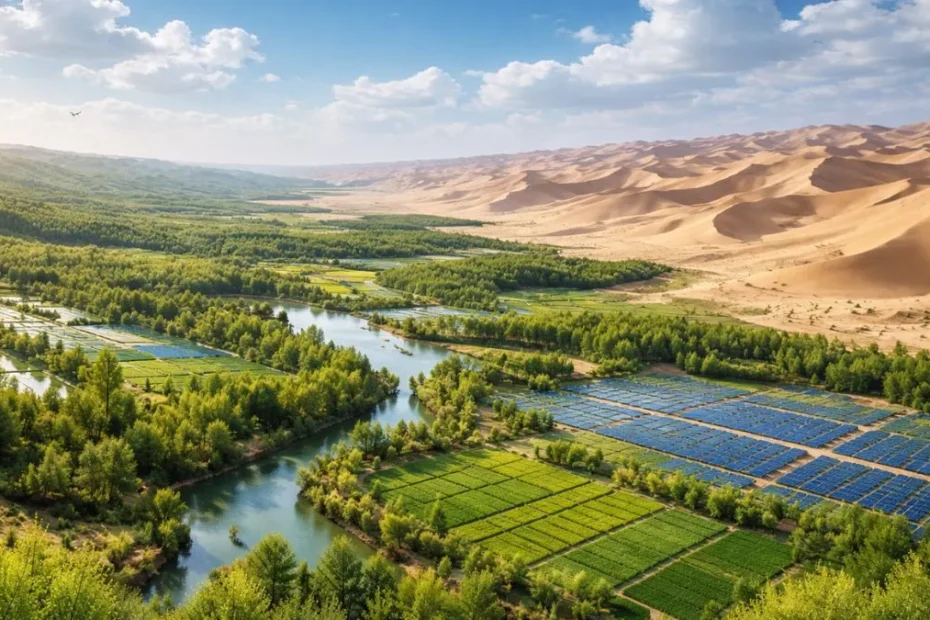
The first thing people notice today in parts of the Taklamakan Desert is not silence, but a gentle rustling sound. Instead of endless wind sweeping across open dunes, there are leaves brushing together — poplars and desert willows growing where sand once stretched for hundreds of kilometers without interruption.
Older forestry workers remember when there was nothing here except shifting dunes. Villages on the desert’s edge watched their farmland slowly disappear under waves of sand.
Pilots feared the region’s powerful dust storms, and communities hundreds of kilometers away suffered from blowing sand carried by strong winds.
Now, the story is changing. Parts of the Taklamakan are turning green — and scientists say some of these newly planted areas are beginning to function as measurable carbon sinks, absorbing CO₂ from the atmosphere.
How China Built a Living Barrier Against the Desert
The Idea of a “Green Wall”
Instead of constructing physical barriers against the sand, planners proposed something bold: create a living wall of trees, shrubs, and grasses. Carefully selected plant species would be arranged in belts around roads, rivers, and vulnerable communities, forming a protective green network.
Satellite images from the late 1990s show the Taklamakan as a massive pale patch on the map. More recent imagery reveals dark green bands tracing highways and the desert’s edge. The difference is striking.
One of the most dramatic examples can be seen along the Tarim Desert Highway, which cuts more than 500 kilometers through the desert. Where there was once only sand, there are now irrigation pipes, drip systems, and shelterbelts of trees — some already taller than nearby buildings.
The Science Behind Desert Greening
Smart Species Selection
This transformation was not random tree planting. Engineers and ecologists tested salt-tolerant poplars, tamarisks, sea-buckthorn, and hardy desert shrubs. Each species was chosen for its ability to survive extreme heat, shifting dunes, and brackish groundwater.
Planting patterns also matter. Workers used checkerboard straw grids to stabilize sand before introducing young trees. This prevents dunes from swallowing saplings before their roots take hold.
Precision Irrigation
Water management is critical in a region where summer temperatures can reach 45°C. Instead of wasteful flooding, drip irrigation systems deliver controlled amounts of groundwater and mountain meltwater directly to each tree’s base. Sensors monitor moisture levels to ensure efficiency.
Every drop counts. Poor irrigation planning could strain fragile aquifers, turning a climate solution into a water crisis.
Taklamakan Desert as a Carbon Sink
As these trees grow, they absorb carbon dioxide (CO₂) through photosynthesis, storing carbon in trunks, roots, and surrounding soil. Field teams have used portable gas analyzers, soil testing tools, and satellite data to measure carbon absorption rates.
Their findings suggest that certain planted zones in and around the Taklamakan are now net carbon sinks — meaning they absorb more CO₂ than they release.
This shift changes the desert’s role in the global climate system. Once known mainly as a major source of dust storms, parts of it now contribute to climate change mitigation.
However, scientists emphasize that greenness alone does not equal carbon storage. Satellite images show vegetation, but real carbon data comes from ground-based measurements of biomass and soil carbon.
The Hidden Work Behind the Headlines
News reports often highlight “billions of trees planted,” but the reality is far more detailed and demanding.
Seasonal workers live for months along the highway in temporary housing. They inspect irrigation lines, replace dead saplings, clear salt crust from soil, and monitor plant health. If a winter freeze destroys a section, they replant it. Maintenance continues year after year.
This long-term care is essential. Without it, plantations could fail.
Risks and Environmental Trade-Offs
While the greening of the Taklamakan is impressive, experts warn about potential risks.
1. Water Stress
Over-planting fast-growing trees may deplete underground water reserves.
2. Monoculture Vulnerability
Single-species plantations are more vulnerable to disease and pests.
3. “Green Deserts”
Some areas may appear lush from above but support little biodiversity on the ground.
4. Ecosystem Disruption
Deserts are not “empty wastelands.” They have native plants, wildlife, and cultural traditions. Overengineering these systems can disturb natural balances.
Scientists now argue for careful targeting: restore degraded land but protect functioning dryland ecosystems.
Lessons for Global Climate Projects
Other countries, including those involved in Africa’s Great Green Wall initiative and Middle Eastern reforestation efforts, are closely observing China’s experience.
Key principles emerging from the Taklamakan project include:
- Choose degraded land carefully
- Match species to local soil and water conditions
- Prioritize water efficiency
- Mix species to strengthen resilience
- Commit to decades of monitoring and maintenance
Large-scale ecological restoration is possible, but it is neither quick nor simple.
A Climate Savings Account — Not a Magic Fix
The transformation of parts of the Taklamakan Desert offers hope. It demonstrates that even extreme environments can be stabilized and made productive in climate terms.
But experts caution against overconfidence. Planting trees does not replace reducing fossil fuel emissions. These desert forests should be viewed as a complementary strategy — a form of ecological “savings account” that stores carbon while broader climate policies evolve.
In villages downwind of new shelterbelts, dust storms are less intense. Some areas report improved local air quality and small increases in biodiversity. These local benefits are tangible.
Yet the global climate fight still depends primarily on cutting emissions at the source.
Key Takeaways
| Key Point | Explanation | Why It Matters |
|---|---|---|
| Desert forests absorb CO₂ | Shelterbelts in the Taklamakan now function as measurable carbon sinks | Shows restoration can support climate mitigation |
| Design determines success | Species mix, irrigation, and maintenance are critical | Prevents ecological failure |
| Water is the limiting factor | Efficient drip systems protect fragile groundwater | Ensures long-term sustainability |
| Restoration has trade-offs | Biodiversity and aquifers must be protected | Encourages balanced climate solutions |
China’s effort to green parts of the Taklamakan Desert shows that even one of the world’s harshest environments can be partially restored through careful planning, scientific monitoring, and long-term commitment. The creation of shelterbelts and managed plantations has reduced dust storms and turned certain zones into measurable carbon sinks, helping absorb atmospheric CO₂.
However, this transformation also highlights the complexity of ecological engineering. Water management, biodiversity protection, and decades of maintenance are essential for success.
While desert greening provides hope, it must complement — not replace — global efforts to reduce fossil fuel emissions. The Taklamakan experiment is both a lesson in resilience and a reminder that climate solutions require patience, balance, and responsibility.
FAQs
1. Is the Taklamakan Desert completely covered in trees now?
No. Only specific areas, especially around highways and vulnerable zones, have been planted. Most of the desert remains natural sand dunes.
2. How do trees in the desert absorb CO₂?
Through photosynthesis, trees take in carbon dioxide from the air and store carbon in their trunks, roots, and surrounding soil.
3. Can planting trees solve climate change entirely?
No. Tree planting helps absorb carbon, but reducing fossil fuel emissions remains the most important solution to climate change.
Related Posts