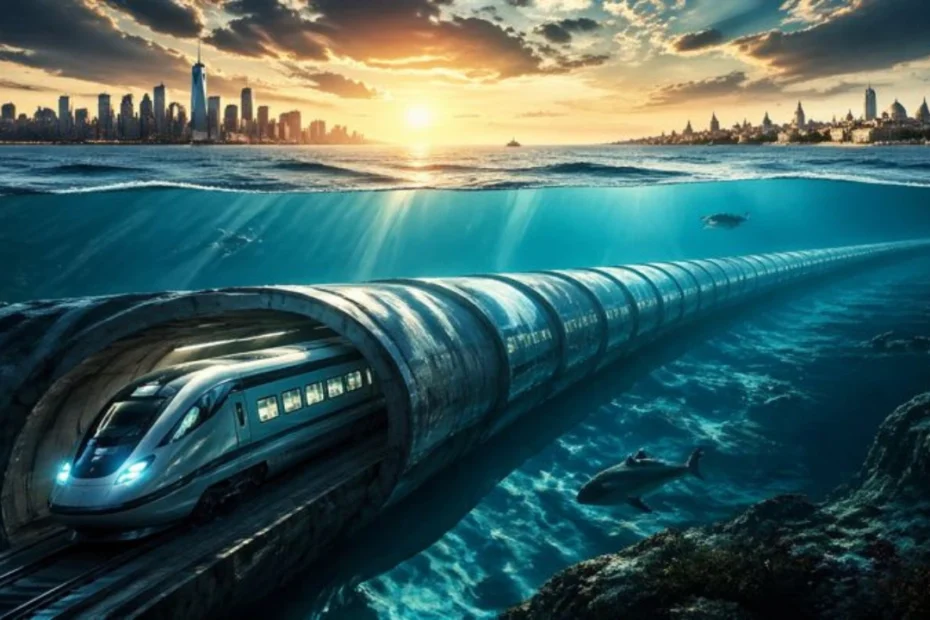
Underwater Rail Line Project: Imagine missing an important family moment just because travel took too long. That’s exactly what happened to Maria Gonzalez when her daughter couldn’t make it from Madrid to New York in time.
Flights got delayed, connections failed, and a journey that should have taken hours turned into a long, stressful experience. Moments like these make people wonder—what if travel was faster, smoother, and more reliable?
Today, that “what if” is slowly becoming real. Engineers have begun building a massive underwater rail line deep beneath the Atlantic Ocean. This project could one day connect continents like Europe and North America with a high-speed train system, changing how we travel forever.
A New Way to Travel Across Oceans
Picture this: you board a train in London, relax with a drink, and within just a few hours, you arrive in New York. No long airport lines. No delays due to bad weather. No luggage headaches. This is the promise of the underwater rail line project.
Engineers are working on building a tunnel that stretches thousands of kilometers under the ocean. These tunnels will go as deep as 4,000 meters below sea level. Each section is made with strong concrete designed to handle extreme pressure.
This is not just another tunnel—it’s being called a new “global connection system” that could completely change how people, goods, and businesses move across the world.
How Engineers Are Building It
Building a tunnel under the ocean is not easy. It requires advanced technology and careful planning. Here’s how the work is happening:
- Giant boring machines dig through rock and soil from both sides of the ocean
- Ships lower heavy tunnel segments into place on the ocean floor
- Special sonar systems map the safest path underwater
- Robots scan ahead to avoid dangerous areas like faults or volcano zones
Engineers must also make sure the project does not harm marine life. This means adjusting routes to avoid whale migration paths and fragile ecosystems.
Project Details at a Glance
| Project Feature | Details |
|---|---|
| Total Tunnel Length | 5,800 km |
| Maximum Depth | 4,200 meters |
| Train Speed | Up to 600 km/h |
| Travel Time | 6–8 hours |
| Estimated Completion | 2045 |
| Current Progress | Around 18% complete |
Construction Timeline
Phase 1 (2024–2028)
Ocean mapping and base setup
Phase 2 (2028–2035)
Main tunnel digging and installation
Phase 3 (2035–2040)
Rail systems and safety testing
Phase 4 (2040–2045)
Final setup and public launch
Why This Project Matters
The underwater rail line is not just about travel—it can change everyday life in many ways.
Economic Benefits
- Businesses can reach global markets faster
- Workers can travel between continents more easily
- New jobs (over 300,000 during construction)
Environmental Impact
- Fewer flights mean lower pollution
- Up to 60% reduction in air travel emissions between continents
Social Impact
- Families can stay connected more easily
- Students can study abroad without long travel stress
Safety Features You Should Know
Safety is the most important part of this project. Engineers are adding multiple layers of protection:
- Emergency rescue capsules
- Safety stations every 500 km
- Real-time monitoring systems
- Earthquake detection sensors
These systems are designed to handle extreme conditions deep under the ocean.
Challenges and Concerns
While the idea sounds exciting, there are still some major concerns:
Environmental Risks
Some scientists worry about the impact on ocean life and ecosystems.
Political Issues
Since the tunnel connects different countries, rules and control can be complicated.
Technical Risks
Building at such deep levels is risky, and any failure could be hard to fix.
Time Delays
Unexpected problems could push the project beyond 2045.
What This Means for the Future
If successful, the underwater rail line project could completely change how we think about distance. Traveling between continents might feel as normal as traveling between cities today.
It could make the world smaller, faster, and more connected than ever before.
Conclusion
The idea of traveling under the ocean might sound like science fiction, but it is slowly becoming reality. This underwater rail line is one of the biggest engineering projects ever attempted, and it has the power to transform global travel. While there are challenges like environmental concerns and high costs, the benefits could be life-changing.
Faster travel, reduced pollution, and stronger global connections make this project truly exciting. If everything goes as planned, future generations may look back and wonder how we ever lived without it.
Related Posts