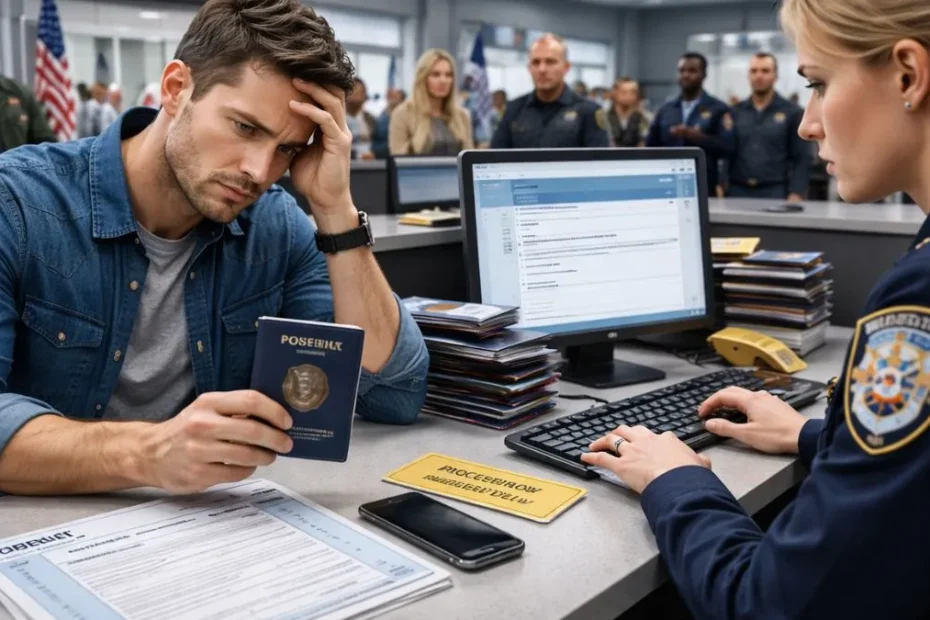
Renewing a U.S. passport is supposed to be simple. You fill out the form, upload your photo, double-check your address, and wait for confirmation. But for some Americans, the process suddenly stops with a vague message: “Your application requires additional review.”
No error code. No explanation. Just a notice that your identity needs “extra verification.”
For many, this is the moment confusion turns into frustration. A routine administrative task becomes a stressful, weeks-long wait — all because of a name.
When a Name Becomes a Security Trigger?
Some names in the United States don’t just appear on paperwork — they activate systems.
Behind every passport renewal application, the U.S. State Department runs automated background checks. These systems compare applicant information against large databases that include:
- Homeland Security watchlists
- FBI criminal indices
- Interpol alerts
- Federal terrorism and security records
On paper, this process is meant to protect national security. In reality, it sometimes leads to unintended consequences.
If your name closely resembles someone listed in a federal database — even if you have no criminal record — your application can be automatically flagged. No arrest. No charges. Just an algorithm that sees similarity and presses pause.
Real-World Consequences of “Name Matches”
Consider the example of a 27-year-old software engineer from New Jersey. His name happened to match someone involved in an old terrorism investigation.
He had:
- No criminal record
- No prior arrests
- No history of travel violations
Yet every attempt to renew his passport ended in “under review” status. His honeymoon had to be canceled. Phone calls to officials led nowhere. The explanation was always the same: “Your file is with another office.”
That short sentence carries significant weight. It means the case is undergoing manual review due to a security flag triggered by data matching.
Why These Delays Happen?
The issue lies in how massive databases interact.
Automated identity systems often rely on:
- Matching first and last names
- Comparing dates of birth
- Checking partial records
- Identifying similar spellings
- Flagging typographical overlaps
These systems prioritize caution. When data creates doubt, the safest default response is delay.
The logic is straightforward: if there’s uncertainty, stop the process until someone verifies it.
But while the system errs on the side of security, the applicant bears the burden.
The Real Cost of a Flagged Passport
A blocked passport renewal is more than an inconvenience. It can result in:
- Missed funerals abroad
- Lost job opportunities requiring international travel
- Cancelled honeymoons or vacations
- Emotional stress and uncertainty
Many affected individuals describe a subtle but powerful feeling — as if their own name has become a liability.
How To Handle a “Flagged” Passport Application?
If your application hits the “additional review” wall, preparation is key.
Step 1: Build a Strong Documentation File
Gather documents that prove your identity clearly and consistently. This often includes:
- Multiple government-issued IDs
- Previous passports (do not discard them)
- Birth certificate
- Naturalization papers (if applicable)
- Marriage or name-change certificates
Think of this as assembling evidence that you are not the person the system may be confusing you with.
Step 2: Don’t Wait in Silence
Many applicants assume the issue will resolve automatically. That’s rarely the case.
Instead:
- Call the National Passport Information Center
- Request a supervisor if necessary
- Ask for written clarification
- Keep detailed records of every interaction
Document:
- Dates of calls
- Names of representatives
- Reference numbers
- Email confirmations
This paper trail demonstrates active follow-up and can help accelerate manual review.
Step 3: Apply Much Earlier Than You Think Necessary
Attorneys who handle civil liberties and passport-related cases often recommend applying well ahead of travel plans — especially if:
- Your name is very common
- You’ve experienced airport screening issues before
- Your name resembles names on publicized watchlists
Extra time can absorb unexpected review periods.
Step 4: Use Congressional Assistance If Delays Continue
If your case extends beyond official processing timelines, you may contact your member of Congress. Congressional offices sometimes assist constituents by making inquiries on stalled federal cases.
While not guaranteed, this step can sometimes push a delayed application forward.
What This Reveals About Data, Identity, and Power?
Stories of passport delays linked to name matches are becoming increasingly common.
Examples include:
- A nurse in Texas whose Arabic surname matched a foreign watchlist entry
- A Latino student whose hyphenated last name confused database systems
- A dual citizen whose middle name caused an emergency passport renewal delay
Each case highlights the same underlying issue: names are no longer just identifiers. They are data points sorted by algorithms.
When an algorithm flags your name, your legal citizenship remains intact — but your access to travel documents can still be paused.
That’s the subtle tension of modern bureaucracy: automated security systems designed for protection sometimes create unintended barriers for ordinary citizens.
Key Takeaways
| Key Point | What It Means | Why It Matters |
|---|---|---|
| Names can trigger automatic holds | Passport systems cross-check with large security databases using imperfect matching | Even innocent applicants can face delays |
| Documentation is critical | Multiple IDs and old records support manual review | Preparation can speed resolution |
| Silence doesn’t help | Follow-up calls and escalation can move cases forward | Active engagement matters |
| Congressional offices may assist | Elected officials can inquire on prolonged delays | You are not entirely powerless |
A passport renewal delay caused by a name match can feel deeply personal, even though it’s driven by automated systems. Security checks are designed to protect national safety, but their reliance on imperfect data matching sometimes affects people who have done nothing wrong.
The key is preparation, persistence, and documentation. If your name has ever triggered scrutiny before, assume it might happen again and plan accordingly.
In today’s data-driven world, citizenship alone does not always guarantee smooth processing — but informed action can reduce the risk of being quietly stalled by an algorithm.
FAQs
1. Why would my passport renewal be flagged if I have no criminal record?
Your name may closely resemble someone listed in federal security databases. Automated systems sometimes flag similar names for manual review.
2. How long does an “additional review” usually take?
It varies. Some cases resolve within weeks, while others can take several months depending on the complexity of the match.
3. Can contacting my member of Congress really help?
In some cases, yes. Congressional offices can request status updates or inquire about prolonged delays, which may accelerate processing.
Related Posts