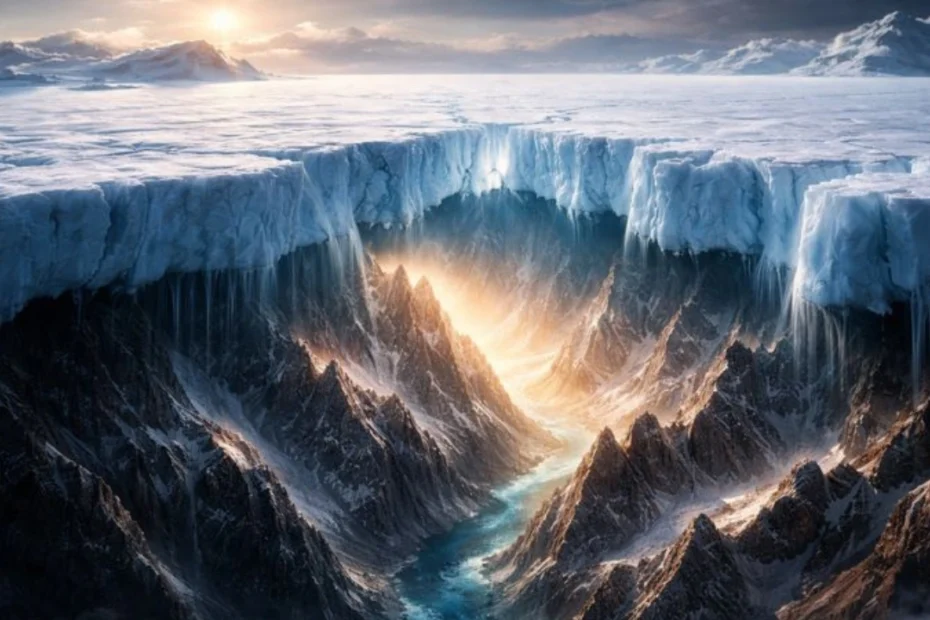
Imagine standing on a frozen surface that looks completely flat and calm. Now imagine that deep below your feet, there are giant mountains, deep valleys, and rough terrain hidden under miles of ice. That is exactly what scientists have discovered in Antarctica. What looks like a smooth white sheet is actually covering one of the most rugged landscapes on Earth.
This new discovery has changed how we understand Antarctica. Thanks to modern technology, scientists can now “see” beneath the ice and map what lies below. The results are shocking—this hidden world is far more complex than anyone expected. Let’s break it down in a simple way.
What Scientists Discovered Beneath Antarctica
A Landscape Full of Mountains and Valleys
Scientists found that Antarctica’s bedrock is twice as rugged as earlier estimates. This means there are many more hills, ridges, and valleys hidden under the ice than we thought.
One of the biggest discoveries is a massive valley system that stretches for hundreds of kilometers. This is not a small feature—it is huge enough to affect how ice moves across the continent.
Scientists compare this hidden terrain to famous mountain ranges like the Rockies or Alps. The only difference is that Antarctica’s version has been buried under ice for millions of years.
How Scientists Mapped the Ice
Advanced Technology Made It Possible
Mapping something under 2–4 kilometers of ice is not easy. Scientists used a mix of modern tools to get accurate results.
Here’s a simple table to understand how each method works:
| Mapping Method | What It Does | Depth Capability |
|---|---|---|
| Radar Surveys | Sends radio waves through ice to detect ground | Up to 4 km |
| Gravity Measurement | Finds changes in rock density below | Deep layers |
| Seismic Surveys | Uses sound waves to study layers | Several km |
| Computer Models | Combines all data into 3D maps | Full continent |
These tools allow scientists to detect even small features just a few meters high, even through thick ice.
Why This Discovery Matters
It Affects Sea Level Rise
This is not just an interesting science story—it has real-world importance.
The shape of the land under the ice controls how glaciers move. Think of glaciers like slow rivers. They follow the path of least resistance, just like water.
- Valleys can speed up ice movement toward the ocean
- Hills can slow down or block the flow
Because of this, the newly discovered valley system could allow ice to move faster into the ocean, which may increase sea level rise. On the other hand, some hills may slow things down.
Scientists are now updating climate models using this new data.
What This Tells Us About Earth’s History
The new map also gives clues about the past. The hidden land shows signs of:
- Ancient rivers
- Old tectonic activity
- Possible volcanic formations
This means Antarctica was not always covered in ice. Millions of years ago, it likely had a very different environment.
What Happens Next?
Scientists are not done yet. This discovery has opened many new questions.
Future plans include:
- Studying how ice moves over this rough terrain
- Tracking changes in real time
- Mapping areas with even more detail
The more scientists learn, the better they can predict how Antarctica will behave in the future.
Conclusion
The latest Antarctic ice mapping has revealed a hidden world that is far more complex than anyone imagined. Beneath the thick ice lies a rugged landscape filled with mountains, valleys, and geological features that play a major role in how glaciers move.
This discovery is not just exciting—it is important for understanding climate change and future sea levels.
As technology improves, scientists are getting closer to fully understanding Antarctica’s secrets. This new map is a big step forward, but it also reminds us how much there is still to learn. The frozen continent may look quiet and simple from above, but underneath, it tells a powerful story about Earth’s past and future.
Related Posts