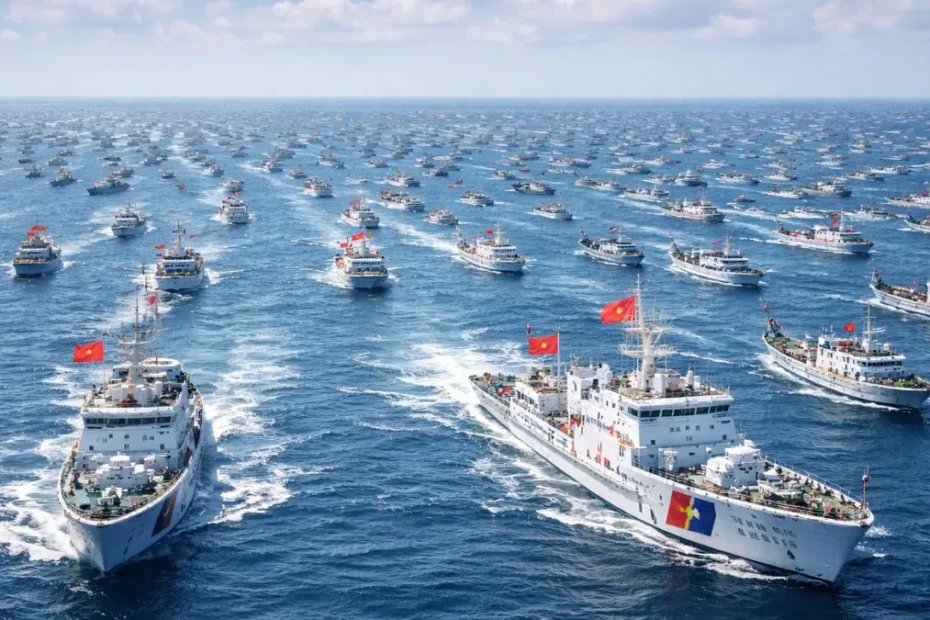
In January, something unusual unfolded across the South China Sea. What appeared at first to be an ordinary gathering of fishing vessels gradually revealed itself as something far more strategic.
Nearly 1,400 Chinese fishing boats quietly assembled into a sweeping formation that stretched close to 200 miles, effectively creating what observers describe as an artificial maritime barrier in disputed waters.
There were no dramatic announcements, no naval warships leading the charge, and no official declaration. Instead, the transformation happened slowly — boat by boat — until open sea began to resemble a floating wall.
A Sea That Suddenly Looked Different
The first signs were subtle. At dawn, scattered green navigation lights blinked across the horizon. But as the camera panned across the water, it became clear that the number of vessels was not normal. Hulls lined up almost continuously.
Diesel engines rumbled through the cold air. Masts formed what looked like a forest rising from the sea.
Those aboard nearby vessels may not have realized it at the time, but they were witnessing the outline of a 200-mile floating formation.
Satellite imagery later confirmed what fishermen had already sensed: the boats were not randomly dispersed. They were forming a coordinated arc across a contested coastline.
When Fishing Fleets Become Strategic Tools?
On paper, these were civilian vessels — wooden boats with chipped paint and fishing gear stacked along the deck. But their positioning told a different story.
By assembling in dense clusters, the fleet functioned less like independent fishing boats and more like a mobile maritime fence.
This tactic is widely described as “gray-zone operations.” It operates between peace and open warfare. There are no missiles launched or naval battles fought. Instead, civilian-looking vessels maintain a heavy presence that changes realities on the water without crossing into declared conflict.
The advantages are clear:
- Persistent presence in disputed waters
- Strategic pressure on neighboring nations
- Plausible deniability, since they are officially “just fishermen”
The power of the tactic lies in staying below the threshold that would trigger a military response.
Impact on Regional Fishermen
For nearby coastal communities, the shift was immediate and practical.
A Philippine captain reported that a previously empty horizon was suddenly filled with Chinese vessel lights. Vietnamese fishermen began exchanging coordinates through messaging apps, warning each other about what they called “the line” — the stretch of sea now densely occupied.
Fishing crews who once operated freely began turning back after encountering what appeared on radar as a continuous cluster of foreign hulls.
For them, this was not a geopolitical theory. It was a daily reality affecting livelihoods.
The Mechanics Behind the Mobilization
Such coordination does not begin at sea. It starts on land.
Reports suggest that before the January deployment, captains were contacted in advance. Incentives included:
- Fuel subsidies
- Special “escort” payments
- Security guarantees
- Participation in organized “patriotic fishing campaigns”
Some vessels are linked to China’s official maritime militia, while others are standard commercial boats encouraged to participate.
When the signal was given, departures appeared staggered and natural. Small groups left over several days. Only later did the larger formation become visible — a dense, shifting arc across open water.
Legal Gray Areas in Maritime Law
One reason the tactic is effective is because international maritime law does not clearly limit how many civilian fishing boats can operate in a specific area.
There is no rule that sets a maximum density of fishing vessels in disputed waters. Nor is there a strict legal definition for when coordinated civilian activity becomes a strategic blockade.
This legal ambiguity fuels the success of gray-zone maritime tactics. Civilian fleets can operate in ways that challenge sovereignty without technically violating declared war thresholds.
That gray space is where strategy thrives.
How Coast Guards Experience the Barrier?
Coast guard officers from neighboring countries describe similar encounters:
- Approaching one boat leads to several others closing in.
- Cameras begin recording.
- Radios transmit in coordinated patterns.
- Any enforcement action risks being labeled as provocation.
The crowding effect turns enforcement into a delicate diplomatic incident.
Instead of a single confrontation, authorities face a coordinated swarm — one that complicates response decisions.
The Strategic Message Behind the Movement
A formation of 1,400 vessels spanning nearly 200 miles is unlikely to be accidental.
Observers often look at timing:
- Was there a stalled diplomatic negotiation?
- Was a security pact recently signed?
- Did an international court ruling trigger tension?
Fishing surges like this frequently coincide with broader political developments.
In that sense, the fleet becomes a maritime signal — a non-verbal message delivered across open water.
Global Ripple Effects
Although this event unfolded in the South China Sea, its consequences extend far beyond regional borders.
Trade and Shipping
Major global shipping routes pass through these waters. If commercial vessels must reroute to avoid “complicated zones,” shipping times increase — and so do costs.
Insurance Adjustments
Maritime insurers quietly modify risk models when activity intensifies in contested regions.
Food Security
Local fishermen in neighboring nations may return home with smaller catches, affecting regional supply chains.
Consumer Impact
Electronics, fuel, and everyday goods often travel through these shipping lanes. Even minor route disruptions can contribute to higher prices globally.
The ripple spreads far wider than the 200-mile arc itself.
How to Recognize a Strategic Fishing Surge?
To better understand similar events in the future, consider three key indicators:
1. Follow the Pattern, Not Just the Headline
Repeated gatherings in the same disputed zones at similar times may indicate deliberate coordination rather than seasonal fishing.
2. Watch the Reaction
If regional coast guards alter patrol routes or reduce presence, the tactic is achieving its intended effect.
3. Separate People from Policy
Not every fisherman is acting as a political agent. Many are simply responding to economic incentives within a structured system.
Recognizing the human element keeps analysis grounded and realistic.
Key Facts at a Glance
| Key Point | Details | Why It Matters |
|---|---|---|
| Scale of Mobilization | Around 1,400 fishing boats formed a 200-mile arc | Indicates coordinated strategy |
| Tactic Used | Gray-zone maritime operations | Avoids open conflict while asserting presence |
| Legal Factor | Exploits maritime law gray areas | Makes enforcement difficult |
| Regional Impact | Disrupts fishing access and patrol routes | Affects livelihoods and security |
| Global Effect | Influences trade routes and insurance costs | Impacts global economy |
The January deployment of 1,400 Chinese fishing boats across nearly 200 miles of contested waters represents more than a crowded fishing season. It reflects a calculated use of gray-zone maritime tactics designed to alter control without triggering open warfare. By operating within the ambiguous space of international maritime law, civilian fleets can reshape geopolitical realities while maintaining plausible deniability.
The implications extend beyond regional tensions — touching trade routes, insurance costs, food security, and global supply chains. In today’s strategic environment, the first moves are often quiet, gradual, and easy to overlook. Yet their impact can be far-reaching and long-lasting.
FAQs
1. What are gray-zone tactics in maritime conflicts?
Gray-zone tactics involve actions that fall between peace and war. They apply pressure using civilian or non-military means without triggering open combat.
2. Why would fishing boats be used instead of naval ships?
Fishing vessels provide plausible deniability. They project presence without appearing as an overt military escalation.
3. Does international law prevent this kind of action?
Maritime law does not clearly limit the number of civilian boats in disputed waters, which creates legal ambiguity that can be strategically exploited.
Related Posts